
What Are Serology Tests?
Serology tests are laboratory examinations that detect antibodies or antigens in blood samples (serum). These tests play a vital role in diagnosing bacterial infections, viral infections, autoimmune diseases, and inflammatory conditions. The basic principle is the antigen-antibody reaction, which is specific — each antibody reacts only with a particular antigen.
One of the most commonly used serological methods in clinical laboratories is the latex agglutination test. This method provides rapid results (within minutes) without requiring expensive equipment, making it very practical for laboratories at various levels of healthcare facilities.
Key Serology Tests and Their Clinical Significance
CRP (C-Reactive Protein)
What is CRP?
An acute-phase protein produced by the liver in response to inflammation. CRP levels increase 6-12 hours after the onset of inflammation.
Clinical significance:
- Bacterial vs viral infection (high CRP indicates bacterial infection)
- Monitoring antibiotic therapy response
- Cardiovascular risk assessment (hs-CRP)
- Active autoimmune disease
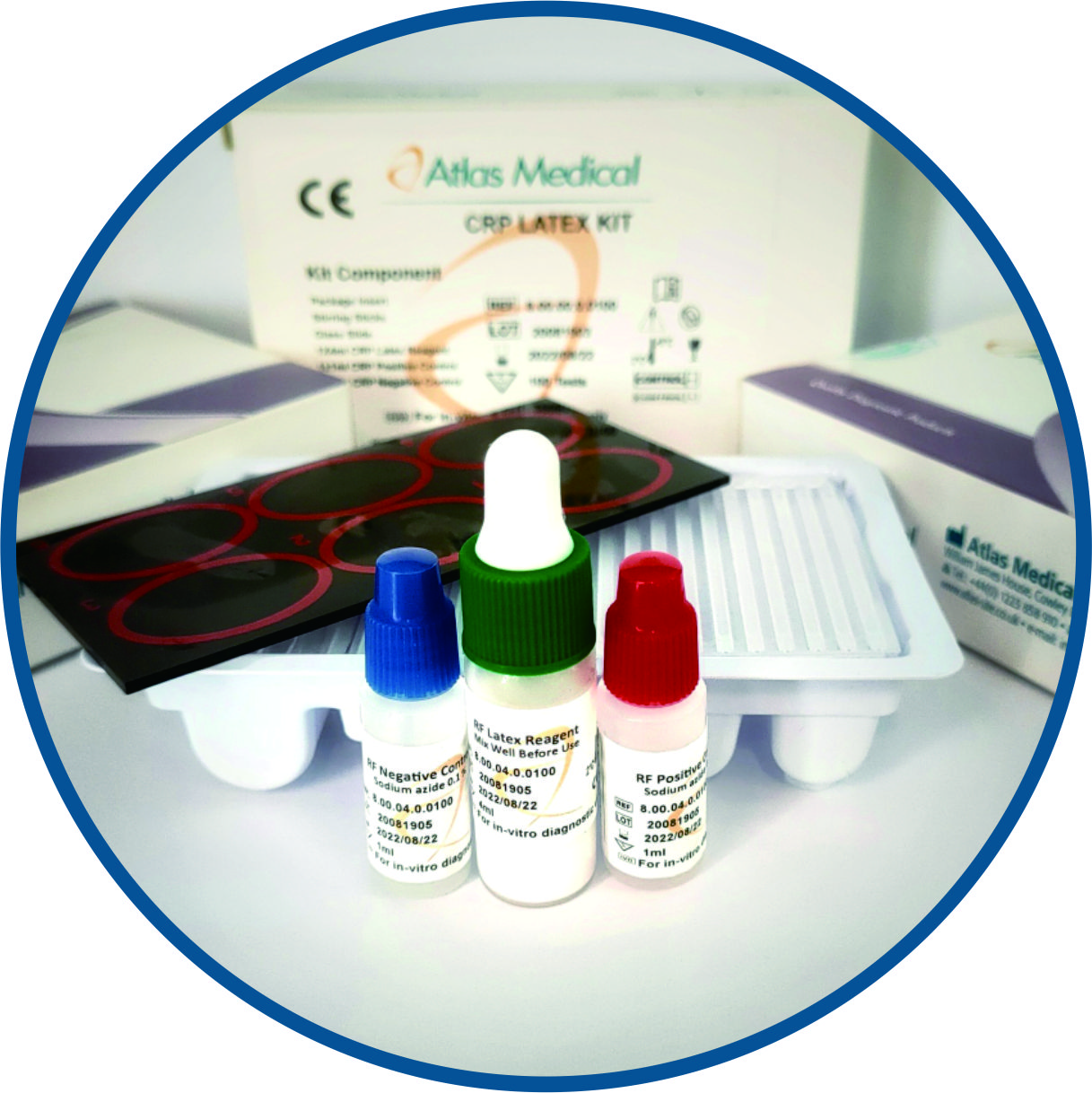
Atlas CRP Latex Kit detects CRP > 6 mg/L through macroscopically visible agglutination.
ASO (Anti-Streptolysin O)
What is ASO?
Antibodies against streptolysin O (a Group A Streptococcus exotoxin). Levels increase 1-3 weeks after streptococcal infection.
Clinical significance:
- Confirmation of recent Streptococcus infection
- Evaluation of rheumatic fever risk
- Diagnosis of post-streptococcal acute glomerulonephritis
- Monitoring antibody titers during treatment
Atlas ASO Latex Kit provides rapid and reliable testing.
RF (Rheumatoid Factor)
What is RF?
An autoantibody (usually IgM) that reacts against the Fc portion of IgG. Commonly found in autoimmune diseases.
Clinical significance:
- Diagnosis of rheumatoid arthritis (RA)
- Sjögren's syndrome
- Systemic lupus erythematosus (SLE)
- Prognosis — high RF = more aggressive disease
Atlas RF Latex Kit uses human IgG on latex particles.
Other Diagnostic Tests from Atlas Medical
| Product | Use | Method |
|---|---|---|
| Blood Grouping Set | ABO and Rhesus blood group determination | Anti-A, Anti-B, Anti-AB, Anti-D monoclonal |
| Salmonella O Reagent Set | Widal test (somatic antigen) | Slide/tube agglutination OA, OB, OC, OD |
| Salmonella H Reagent Set | Widal test (flagellar antigen) | Slide/tube agglutination HA, HB, HC, HD |
The Importance of Quality Reagents
Reagent quality greatly affects the accuracy of serological results. Atlas Medical UK produces reagents to international standards:
- Calibrated against WHO international reference preparations
- Blood grouping reagents from In-Vitro hybridoma cell culture supernatant (monoclonal antibodies)
- Strict quality control at every production batch
- CE Mark certification for European quality assurance
- Long reagent stability after opening
Latex Serology Test Procedure
- Drop 50 µL of patient serum onto the slide card circle
- Add 1 drop of latex reagent next to the serum
- Mix with a disposable stirrer evenly
- Gently rock the slide card for 2 minutes
- Read the results under bright light — agglutination = positive, homogeneous = negative
- For quantitative titers, perform serial dilutions and repeat the procedure